
Introduction
In today’s visual world, people connect more with images than plain text. This is where illustration and artwork play a major role. From children’s books and websites to advertisements and social media, illustrations help communicate ideas quickly and effectively.
Illustration is not just about drawing something attractive — it is about telling a story, explaining a concept, and creating an emotional connection with the audience. Whether you are a designer, a business owner, or a beginner artist, understanding illustration can help you improve your visual communication.
What is Illustration?
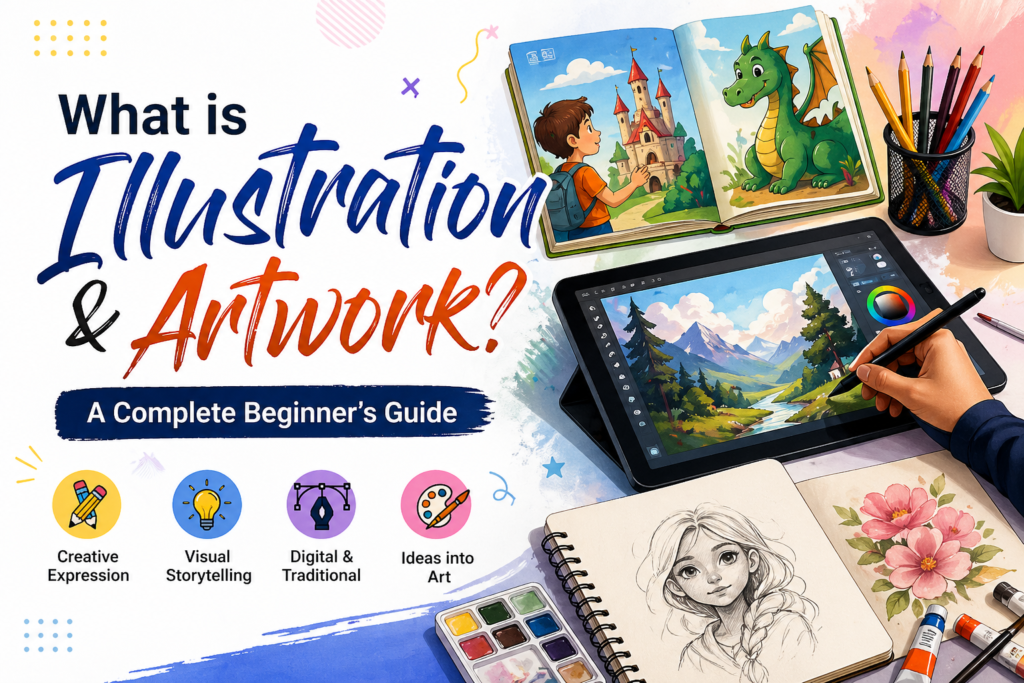
Illustration is the art of creating images that support or explain a concept, story, or idea. It can be simple like a small icon or complex like a full-page artwork in a book.
For example, in children’s books, illustrations help kids understand the story even if they cannot read properly. In websites, illustrations make content more engaging and visually appealing.
Unlike random drawings, illustrations are usually purpose-driven, meaning they are created to communicate something specific.
What is Artwork?
Artwork is a broader term that includes all types of creative visual expressions. It can include:
- Illustrations
- Paintings
- Graphic design
- Typography
- Digital art
In simple words, every illustration is artwork, but not every artwork is illustration. Artwork focuses more on creativity and expression, while illustration focuses on communication.
Types of Illustration (Explained in Detail)
1. Digital Illustration

Digital illustration is created using software like Photoshop, Illustrator, or Procreate.
- It allows easy editing and corrections
- Artists can experiment with unlimited colors and effects
- It is widely used in modern design, marketing, and publishing
Because of its flexibility, digital illustration is the most popular type today.
2. Hand-Drawn Illustration

This type is created using traditional tools like pencils, pens, ink, or watercolor.
- It gives a natural and authentic feel
- Each piece is unique and expressive
- It is often used in artistic and premium projects
Even today, many artists prefer hand-drawn work for its originality.
3. Vector Illustration

Vector illustrations are made using shapes and paths instead of pixels.
- They are scalable without losing quality
- Perfect for logos, icons, and branding
- They have a clean and modern look
This type is highly useful for businesses and professional design work.
4. Children’s Illustration

Children’s illustrations are designed specifically for young audiences.
- They use bright colors and simple shapes.
- Characters are expressive and fun.
- They help children understand the story more easily.
This type of illustration is widely used in storybooks, learning materials, and educational content.
Why Illustration is Important in Design
1. Enhances Visual Storytelling
Illustrations make stories more engaging and easier to understand. A single image can explain what a paragraph of text cannot.
2. Grabs Attention Quickly
People scroll fast, especially on social media. A good illustration can instantly capture attention and make users stop and look.
3. Improves User Experience
On websites and apps, illustrations make content more interactive and less boring, improving overall user experience.
4. Builds Strong Brand Identity
Unique illustrations help brands stand out. Many successful brands use custom illustrations to create a recognizable style.
5. Simplifies Complex Ideas
Illustrations can break down complicated concepts into simple visuals, making them easier to understand for everyone.
Where Illustration is Used
Illustration is used in many fields, such as:
- Books and Publishing (especially children’s books)
- Web Design and Apps
- Advertising and Marketing
- Social Media Content
- Branding and Packaging
Because of its versatility, illustration is one of the most in-demand creative skills today.
Basic Skills Required to Start Illustration
- Drawing Fundamentals – Understanding shapes, proportions, and perspective
- Color Theory – Knowing how colors work together
- Creativity & Imagination – Thinking of unique ideas
- Software Knowledge – Learning tools like Photoshop or Illustrator
- Observation Skills – Noticing details in real life
You don’t need to be perfect at the start — practice is what improves your skills over time.
Conclusion
Illustration and artwork are powerful tools that combine creativity with communication. They are not only important for artists but also for businesses and designers who want to stand out in a competitive market.
If you are just starting, focus on learning the basics and practicing regularly. With time, you will develop your own unique style and improve your skills. Illustration is not just a skill — it is a way to express ideas visually and creatively.